They resist mergers, market shifts, strategic hires and key retirements. This is not because they are perfect, but because changing them involves something management prefers to avoid: addressing critical issues with people.
I have seen small and medium-sized businesses double their revenue in eight years without updating the organisational chart. This is not due to forgetfulness, but to prudence. Moving someone means renegotiating balances between partners, altering informal hierarchies and offending established sensibilities. It’s easier to avoid changes.
The problem is that a structure which doesn’t evolve alongside the company becomes a hindrance. Inefficiencies silently accumulate. Responsibilities overlap. Decisions take longer than necessary.
However, there is a way to approach the organisation that does not feel like a trial to those involved. It’s called Process Value Analysis and can be applied to the system by H. James Harrington, who described it in his work, Business Process Improvement (1991).
Harrington and Process Value Analysis
James Harrington was among the first to argue that improving business efficiency does not involve directly intervening with people, but rather with the processes in which they work. His insight was simple yet powerful: before reorganising who does what, it is essential to understand which activities create value and which do not.
The model classifies all a company’s activities into three categories:
RVA (Real Value Added): activities for which the customer pays. These activities directly relate to what the customer purchases, such as manufacturing, providing the service and delivery. Any activity that does not contribute to this goal may be reviewed. BVA (Business Value Added): activities that are necessary for the company’s operation but which are not perceived as having direct value by the customer. These include accounting, regulatory compliance, internal controls and payroll management. These activities are essential but must be streamlined. NVA (No Value Added): activities that add no value to either the customer or the company. Examples include waiting, duplication, redundant checks, avoidable error corrections and unnecessary movement of information or materials. These must be eliminated.
The strength of the model lies in the fact that the analysis focuses on activities rather than people. No one is evaluated. The process is improved.
Four steps to applying it in an SME
The implementation process does not require external consultants or specialised software. It requires time, a methodical approach, and a willingness to question what is usually taken for granted.
- Map the value chain. Start by identifying the company’s main processes, from customer order to delivery and from supplier purchasing to payment. A perfect diagram isn’t necessary. A list of the activities that make up each process, in the order in which they occur, is sufficient.
- Classify each activity. Ask Harrington’s question of each activity on the list: would the customer pay for this if they knew about it? If so, it is an RVA. If it is necessary for the company, but the customer does not see it, then it is a BVA. If it is neither, it is NVA.
- Quantify the weight of each category. Once the activities have been classified, estimate the time or cost absorbed by each category. In some companies that I have analysed, NVA activities range from 20% to 40% of operating time. When this data is presented objectively to management, it has an immediate impact.
- Plan improvement actions. NVAs should be eliminated. BVAs should be optimised, and automated where possible and cost-effective. RVAs should be protected and expanded. At this stage, the analysis becomes a reorganisation project, based not on hierarchies but on value streams.
The administrative manager plays a key role in this analysis
In an SME, the administrative manager is often best placed to carry out this analysis. This is not because they are process experts, but because they have something no other manager has: cross-departmental visibility, enabling them to intervene impartially.
They can make a significant contribution, especially in processes that connect different departments or functions. They know how to intervene in the information system to improve the use of this often-undervalued resource.
With the Harrington model, this becomes a tool. The administrative manager can document and classify activities and present them to management, showing where value is being created and wasted using data.
This approach has an additional advantage in that it depersonalises the discussion. When reorganisation is proposed based on a process analysis, resistance to change is reduced. It’s not about saying, “Mario works poorly.” It’s about stating that “this process accounts for 35% of activities with no added value”.
A shift in perspective that produces concrete results
Process Value Analysis is not a magic tool. It’s a method of seeing more clearly how a company transforms its resources into value.
When applied seriously by an SME, the results are tangible. Processes are simplified. Responsibilities are distributed more consistently in line with actual workload. Performance evaluations improve. The formal organisation reflects the actual organisation.
Often, what seemed like a people problem turns out to be a design problem. It’s a problem with a solution.
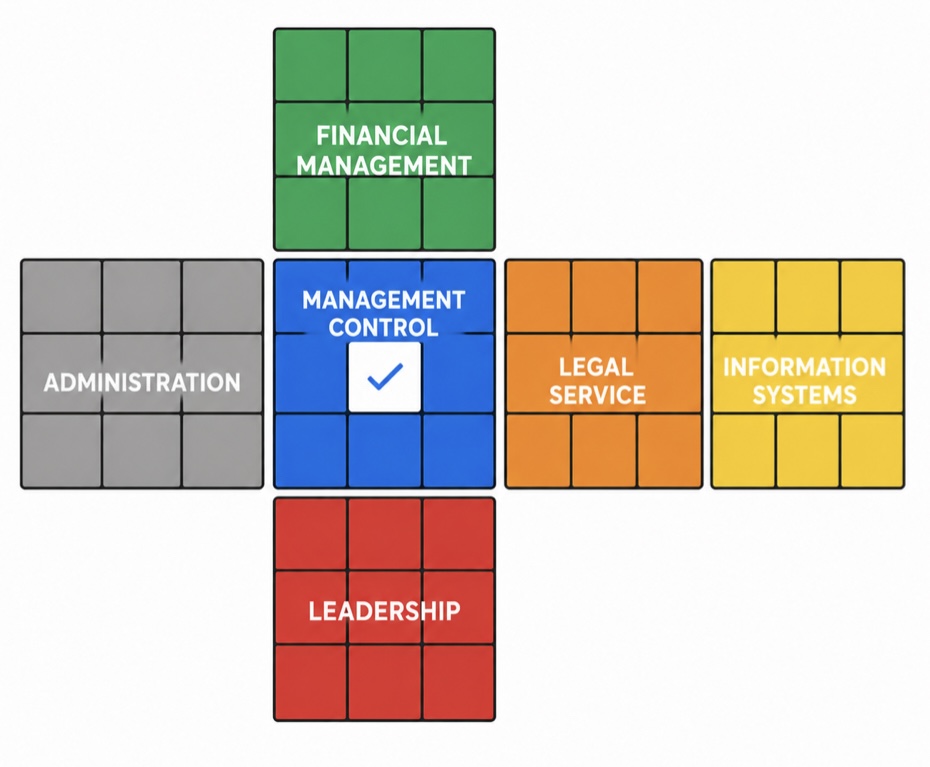
The Rubik’s Cube of administration has a solution. This is one of its pieces.
Want to receive content directly? Follow us on LinkedIn (@Pietro Cavalli) to never miss a step.
Kenning Consulting supports small and medium-sized businesses in strengthening their administrative function and implementing practical management control tools tailored to their needs.